
Raising a Bilingual Child: Is It Really Causing Speech Delay?

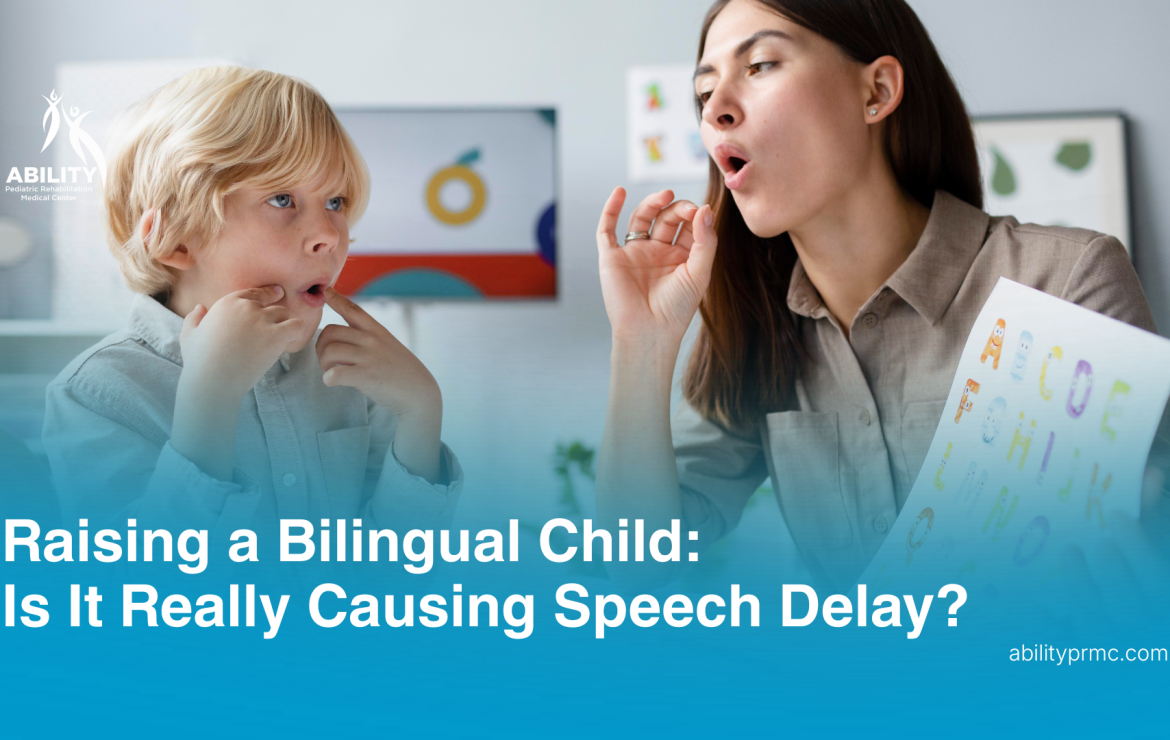
In Abu Dhabi, most children grow up hearing more than one language — Arabic and English at minimum, often a third at home and a fourth from a nanny or at nursery. And almost every parent raising a multilingual child eventually hears the same well-meant advice: “Pick one language, you’re confusing him.” So is there truth to it? Does raising a bilingual child cause speech delay? The research on this is unusually clear, and the answer will reassure most parents — while pointing a few others towards help they should not delay.
| Quick answer No. Raising a child with two or more languages does not cause speech or language delay, and it does not cause language disorders. Bilingual children reach key milestones — first words, first phrases — within the same typical windows as monolingual children. What can differ is how vocabulary is distributed across languages: counted in one language alone, a bilingual child may seem behind, but counted across both, their total vocabulary is typically age-appropriate. If a genuine delay exists, it will appear in both languages — and it was not caused by bilingualism. |
Where the myth comes from
The advice is old, widespread, and was never well founded. It persists for two understandable reasons.
First, bilingual children are often compared using the wrong measure. If a three-year-old knows 300 words in English and 250 in Arabic, and you count only the English, you might conclude she is behind. Count both, and she is comfortably ahead of where you would expect. Almost all standardised norms are built on monolingual children, which makes single-language comparison misleading by design.
Second, bilingual children do things that look like confusion but are not — which brings us to the most misunderstood behaviour of all.
Mixing languages is a skill, not a symptom
Children who mix languages within a sentence — “I want the عصير” — are not confused. This is called code-switching, and it is a normal, well-documented feature of bilingual development. Adult bilinguals across the world do it constantly.
Far from indicating a problem, code-switching demonstrates that a child knows they have two systems and is selecting between them, usually filling a gap with whichever word they can retrieve fastest. Bilingual children also reliably match language to person from a young age — speaking Arabic to a grandparent and English to a teacher — which is itself evidence of sophisticated processing, not muddle.
What is normal for a bilingual toddler
These are all expected, and none is a reason for concern on its own:
- Mixing languages in one sentence.
- Being stronger in one language than the other — and having that flip over time, for example when they start nursery.
- Having a smaller vocabulary in each individual language than a monolingual peer, while the combined total is on track.
- Going through a quiet period when a new language is introduced — sometimes called the silent period — during which the child listens and absorbs before producing.
- Preferring one language for certain topics (school words in English, family and food words in Arabic).
- Responding in one language when addressed in another.
| The rule that cuts through it: count both languages together. A bilingual child’s total vocabulary across all their languages — not their score in whichever language you happen to be measuring — is the meaningful figure. |
When it is not just bilingualism
This is the part that matters, because “it’s just because he’s bilingual” is one of the most common reasons families delay getting help — sometimes by years. Bilingualism explains a lot. It does not explain everything.
A genuine language difficulty shows up in both languages. If your child is behind in Arabic and in English, bilingualism is not the reason. Seek an assessment if your child:
- Is not babbling by 12 months.
- Uses no gestures — no pointing, showing or waving — by 12 months.
- Has no single words in any language by 16 months.
- Is not combining two words in any language by 24 months.
- Has a total vocabulary across all languages that is clearly small for their age.
- Struggles to understand simple instructions in their strongest language.
- Is very difficult for familiar adults to understand by around age 3.
| Never attribute this to bilingualism: if your child loses words, babbling or social skills they previously had — in any language, at any age — seek professional advice promptly. Regression is never explained by learning two languages. |
The advice that does real harm
Occasionally families are told that if a child has a language delay, they should drop one language and concentrate on the other. This advice is not supported by evidence, and it can cause genuine damage.
Research on children with language disorders — including autistic children and children with Down syndrome — has not found that reducing to one language improves their language outcomes. What it does do is cut a child off. In a family where grandparents speak only Arabic, removing Arabic can isolate a child from half their family, their culture and their community. The cost is real; the benefit has not been demonstrated.
Sound practice is to support all the child’s languages, and to deliver therapy in the language or languages the child actually lives in.
How to support a bilingual child well
- Speak the language you are most fluent in. Children learn best from rich, natural, comfortable language. A parent speaking imperfect English is giving their child less than the same parent speaking fluent Arabic.
- Be reasonably consistent. Many families use one-parent-one-language, or one language at home and another outside. Any consistent pattern helps — but do not be rigid about it to the point of stress.
- Quantity and quality both matter. A language needs meaningful daily exposure to develop. Passive exposure through a screen does not count; interaction does.
- Read in both languages. Books build vocabulary faster than conversation alone.
- Do not correct the mixing. Simply model the full sentence back in one language and move on.
- Value both languages openly. Children absorb which languages carry status. A language a child feels embarrassed about is a language they will stop using.
What a bilingual assessment should look like
If you do seek help, it matters who you see. Assessing a bilingual child using only English norms is one of the most common causes of misdiagnosis — in both directions. Children have been wrongly identified as delayed when they were simply still building English, and others have had genuine difficulties dismissed as “just bilingualism”. A proper speech and language therapy assessment for a multilingual child should:
- Gather a full picture of which languages the child hears and uses, with whom, and how much.
- Assess ability across all of the child’s languages — not English alone.
- Involve a therapist who speaks the child’s language, or a trained interpreter.
- Interpret results against bilingual expectations rather than monolingual norms.
- Include the family’s own report, which is often the most accurate source on home-language ability.
How we support bilingual families in Abu Dhabi
Ability Pediatric Rehabilitation Medical Center is a CARF-accredited, MOH-licensed child development centre in Abu Dhabi, working with families across the full range of language backgrounds our city contains. Our speech and language therapists assess and treat in Arabic and English, consider a child’s whole language profile rather than one language in isolation, and never advise families to give up a language. Where broader support is helpful, early intervention and our wider therapy team are available under the same roof.
If you are unsure whether your bilingual child’s speech is on track — or you have been told to “wait and see” and it does not sit right — our guide to the red flags for speech delay is a useful next read, or book a bilingual speech assessment and we will give you a clear answer.
Frequently asked questions
Does raising a bilingual child cause speech delay?
No. Research consistently shows bilingual children reach key milestones such as first words and first two-word phrases within the same typical windows as monolingual children. Bilingualism does not cause speech or language disorders.
My bilingual toddler mixes both languages in one sentence — is that a problem?
No. This is called code-switching and it is a normal, expected feature of bilingual development. It shows the child is managing two language systems, not confusing them. Adult bilinguals do it too.
Should I drop one language if my child has a speech delay?
No. Evidence does not support reducing to one language, and doing so can cut a child off from family, culture and community. Support all the child’s languages and deliver therapy in the languages they actually use.
How many words should my bilingual 2-year-old have?
Count across all their languages combined, not one alone. By 24 months most children are combining two words into short phrases — and for a bilingual child, doing so in any language counts. If they are not combining words in any language, seek an assessment.
Will my child be behind at school because we speak two languages at home?
No. Bilingualism is not a disadvantage academically, and children typically catch up quickly in the school language with good exposure. Maintaining the home language supports rather than hinders overall language development.
My child understands Arabic but only replies in English. Is that normal?
Yes, this is very common and is known as receptive bilingualism. It usually reflects which language the child gets most practice speaking. Continue speaking Arabic to them and give them relaxed opportunities to respond in it.
When should a bilingual child see a speech therapist?
Use the same red flags as for any child — no babbling by 12 months, no words by 16 months, no two-word phrases by 24 months, or any loss of skills. The key difference is that these should be judged across all the child’s languages combined.
Sources
Write a Comment