


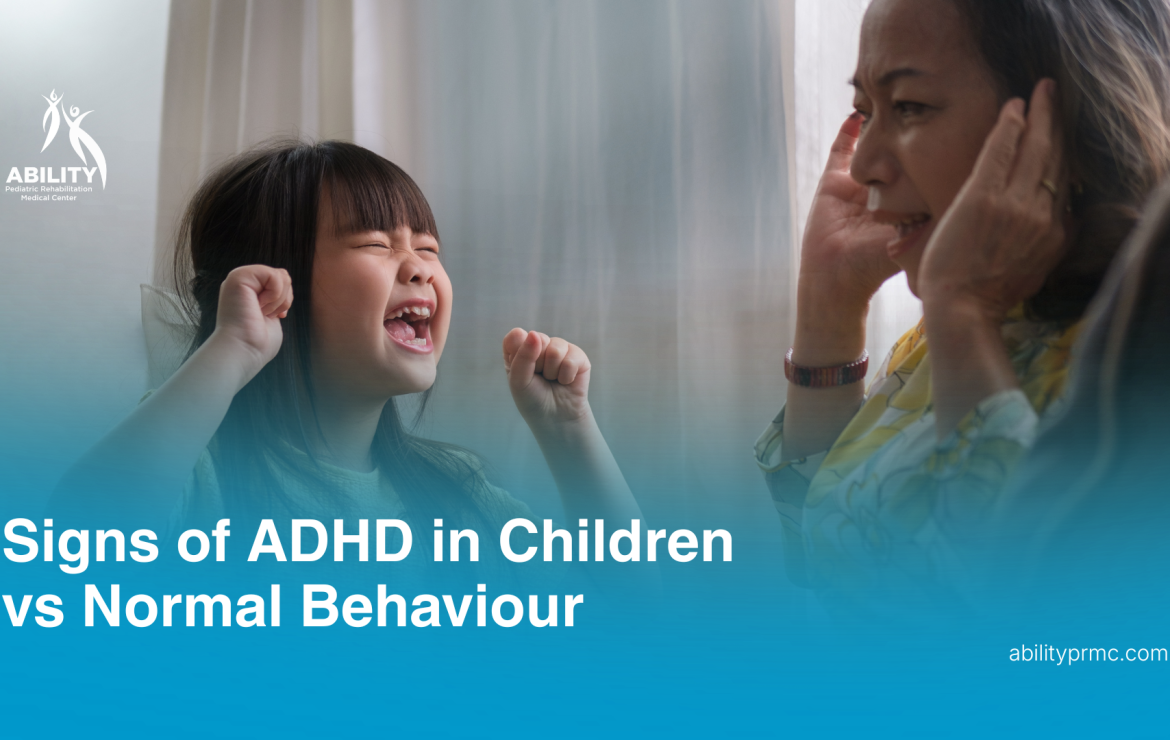
All young children are energetic. All young children lose focus, interrupt, fidget and forget what you just asked them to do. So how do you tell ordinary childhood from something that needs support? Understanding the signs of ADHD in children — and, just as importantly, what separates them from typical behaviour — helps you decide whether an assessment is worth pursuing, rather than either worrying unnecessarily or missing something that could be helped.
| Quick answer The signs of ADHD in children fall into two groups: inattention (easily distracted, does not seem to listen, loses things, avoids sustained mental effort) and hyperactivity-impulsivity (constant movement, cannot stay seated, interrupts, cannot wait their turn). What separates ADHD from normal childhood behaviour is not the behaviour itself but four things: the symptoms are frequent and persistent for at least six months, they appear in two or more settings such as home and school, they began before age 12, and they genuinely interfere with daily life and learning. |
The four questions clinicians actually ask
Almost every parent who worries about ADHD has watched their child bounce off the walls and wondered. What a clinician looks at is not whether the behaviours exist — they exist in most children — but whether they meet these four conditions.
| What clinicians check | Why it matters |
| Persistence | Symptoms have been present for at least six months — not a difficult few weeks after a house move or a new sibling |
| More than one setting | Difficulties appear in at least two environments, such as home and school. Behaviour that only occurs in one place usually points elsewhere |
| Early onset | Several symptoms were present before age 12, even if they were only recognised later |
| Real impairment | The symptoms genuinely get in the way of learning, friendships or family life — not simply that the child is livelier than their siblings |
That second point is the one that most often reframes things for parents. A child who is disruptive at school but calm and focused at home, or vice versa, is telling you something — but it may be about the environment, anxiety, a learning difficulty or a hearing problem rather than ADHD.
The two presentations of ADHD
ADHD is not one single picture. Clinicians describe three presentations: predominantly inattentive, predominantly hyperactive-impulsive, and combined — which is the most common in children.
Inattentive signs
- Makes careless mistakes; misses details in schoolwork.
- Struggles to sustain attention on tasks or play.
- Does not seem to listen when spoken to directly, even without any hearing difficulty.
- Does not follow through on instructions; leaves tasks unfinished.
- Difficulty organising tasks, belongings and time.
- Avoids or dislikes activities requiring sustained mental effort.
- Frequently loses things — water bottles, homework, jumpers, shoes.
- Easily distracted; forgetful in daily routines.
Hyperactive and impulsive signs
- Fidgets, squirms, taps hands or feet constantly.
- Leaves their seat when expected to stay seated.
- Runs or climbs when it is not appropriate; in older children, a persistent feeling of restlessness.
- Difficulty playing quietly.
- Often “on the go”, as if driven by a motor.
- Talks excessively; blurts out answers before the question is finished.
- Difficulty waiting their turn; interrupts conversations and games.
| The presentation that gets missed: quiet, daydreamy children with inattentive ADHD often go unnoticed for years, because they are not disruptive. They are frequently described as “away with the fairies” or “not trying hard enough”. Inattentive ADHD is also more likely to be missed in girls. A child who is struggling quietly deserves the same attention as one who is struggling loudly. |
ADHD or just being a child? A practical comparison
This is the distinction parents most want, so here it is directly — with the caveat that no table replaces an assessment.
| Typical childhood behaviour | More consistent with ADHD |
| Loses focus on boring tasks, but can concentrate on things they enjoy for long stretches | Struggles to sustain attention even on preferred activities, or hyperfocuses so intensely they cannot switch away |
| Energetic and busy, but can settle when the situation requires it | Cannot settle even when strongly motivated to; restlessness is constant rather than situational |
| Forgets instructions occasionally | Forgets routinely, across settings, despite reminders and consequences |
| Interrupts when excited | Interrupts constantly despite understanding the rule and wanting to follow it |
| Behaviour improves steadily with age and clear boundaries | Difficulties persist for six months or more and are not resolved by consistent parenting |
| Difficulties in one setting only | Difficulties present at home, at school and often socially |
What ADHD is not
Some things are worth stating plainly, because parents in the clinic room raise them constantly and often carry unnecessary guilt.
- It is not poor parenting. ADHD is a neurodevelopmental difference in how the brain manages attention, impulse control and executive function. Good parenting helps a child manage it; it does not cause or cure it.
- It is not sugar. Despite how persistent this belief is, sugar has not been shown to cause ADHD.
- It is not laziness or defiance. Most children with ADHD are trying hard. The gap between effort and outcome is exactly what makes it so demoralising for them.
- It is not a lack of intelligence. ADHD occurs across the full range of ability, and many children with ADHD are bright and creative.
- It is not caused by screens. Heavy screen use can worsen attention and sleep, and is worth managing — but it is not the underlying cause.
Other things that can look like ADHD
A proper assessment does not just confirm ADHD — it rules other things in or out. This is why self-diagnosis from an online checklist is risky. Conditions that can resemble ADHD include:
- Hearing difficulties. A child who cannot hear clearly may appear inattentive or non-compliant.
- Sleep problems. Chronic poor sleep produces inattention and irritability that mimic ADHD closely.
- Anxiety. An anxious mind is a distracted mind; restlessness is also a common anxiety symptom.
- Learning difficulties. A child struggling to read may switch off in class — which looks like inattention but is not.
- Sensory processing difficulties. A child overwhelmed by a noisy classroom may appear hyperactive or unfocused.
- Autism. There is meaningful overlap, and the two frequently co-occur — our guide on how autism and ADHD differ explains this in detail.
- Significant life stress. A bereavement, a move, or difficulty at home can produce a genuine but temporary change in attention and behaviour.
At what age can ADHD be identified?
Most children are identified during the primary school years, when sustained attention and sitting still start to matter academically. Diagnosis is possible in preschoolers, but it requires particular care — high activity levels and short attention spans are developmentally normal at three or four, so clinicians assess very young children cautiously and often observe over time.
The requirement that symptoms be present before age 12 does not mean a child must be diagnosed by then. Many children — particularly those with the inattentive presentation, and particularly girls — are identified much later, once academic demands increase.
What an ADHD assessment involves
There is no single blood test or scan for ADHD. A proper ADHD assessment builds a picture from several sources:
- A detailed developmental and family history taken with you.
- Standardised rating scales completed by parents and — crucially — by teachers, since the two-settings requirement cannot be checked from home alone.
- Direct observation and clinical interview with your child.
- Screening for other explanations — hearing, sleep, anxiety, learning difficulties and autism.
- Assessment of functional impact on learning, friendships and family life.
You should come away with a clear formulation and a practical plan — not just a label.
What helps
Support for ADHD is layered, and much of it is behavioural and environmental rather than medical.
- Parent training and behavioural strategies. For younger children in particular, parent training is recommended as a first-line support and is highly effective.
- School accommodations. Seating, movement breaks, chunked instructions, extra time — small changes with large effects.
- Occupational therapy. Helps with sensory regulation, attention strategies, handwriting and organisation.
- Behavioural support. Structured approaches to routines, transitions and emotional regulation.
- Medication. For some children, prescribed and monitored by a qualified physician, it is an effective part of a broader plan. This is always a medical decision made with a doctor — never a first or only step.
How we support families in Abu Dhabi
Ability Pediatric Rehabilitation Medical Center is a CARF-accredited, MOH-licensed child development centre in Abu Dhabi. Our clinical psychology team carries out thorough assessments that consider ADHD alongside the alternatives, and we deliver support through behaviour intervention, occupational therapy and structured parent training — working with your child’s school so strategies apply where they are needed most.
If your child is struggling to focus, sit still or keep up at school, book an assessment and we will help you understand what is behind it.
Frequently asked questions
At what age can ADHD be diagnosed?
Most children are identified during the primary school years. Diagnosis is possible in preschoolers but requires caution, since high energy and short attention spans are developmentally normal at that age. Symptoms must have been present before age 12, though identification often comes later.
Can a child have ADHD and still focus on things they enjoy?
Yes, and this confuses many parents. A child with ADHD may play a favourite game for hours — sometimes called hyperfocus. ADHD affects the regulation of attention, not the capacity for it. Being able to concentrate on something enjoyable does not rule ADHD out.
Is ADHD caused by too much screen time or sugar?
No. Neither causes ADHD. Excessive screen use can worsen attention and sleep and is worth managing, but it is not the underlying cause. The sugar link has not been supported by research.
Does my child need medication for ADHD?
Not necessarily. Behavioural strategies, parent training and school accommodations are first-line support, particularly for younger children. Medication helps some children as part of a broader plan, and is always a decision made with a qualified physician.
Can girls have ADHD?
Yes. Girls are more likely to have the inattentive presentation, which is quieter and more easily missed, so they are often identified later. A girl who daydreams and struggles to organise herself deserves the same consideration as a boy who cannot sit still.
Can a child have both ADHD and autism?
Yes. The current diagnostic criteria explicitly allow both to be diagnosed together, and co-occurrence is common. A thorough assessment looks at both rather than assuming one explanation.
Will my child grow out of ADHD?
Symptoms often change with age — visible hyperactivity commonly reduces, while inattention and organisational difficulties may persist. Many people manage ADHD well into adulthood with the right strategies and support.
Sources
Write a Comment