


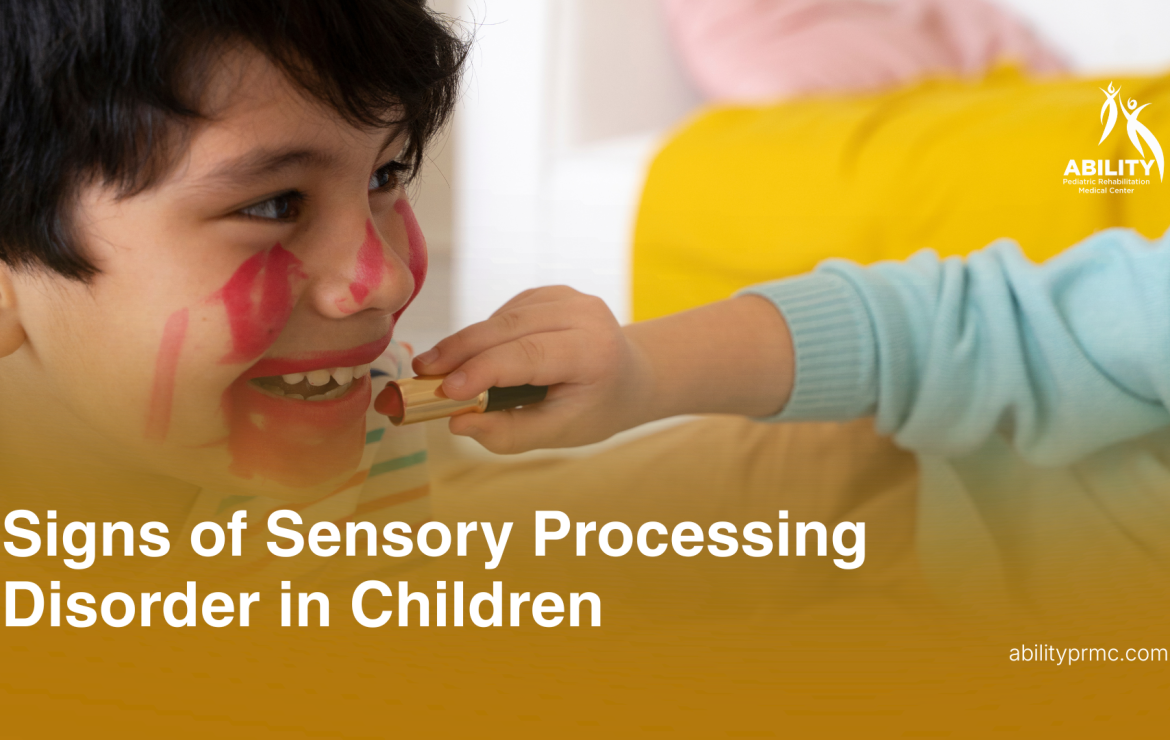
Some children cover their ears at the sound of a hand dryer. Some cannot bear the label in a t-shirt, or gag at the texture of certain foods. Others seem to crash into everything, spin endlessly without getting dizzy, or never seem to notice when they have hurt themselves. If any of this sounds like your child, you may have found yourself searching for the signs of sensory processing disorder — and wondering whether there is a name for what you are seeing, and whether anything can help.
There is. And there is something important to understand up front, which many articles on this topic skip over.
| Quick answer Sensory processing difficulties describe a child’s struggle to interpret and respond comfortably to everyday sensory information. The common signs are over-sensitivity (distress at sounds, textures, lights, food or clothing), under-sensitivity (not noticing pain, cold or their name being called), and sensory-seeking (constant movement, crashing, spinning, chewing). These difficulties are very real, but “Sensory Processing Disorder” is not currently a standalone diagnosis in the DSM-5 — sensory differences are most often seen as part of autism, ADHD, anxiety or developmental delay. Occupational therapy is the main form of support. |
An honest note on the diagnosis
Parents deserve a straight answer on this, because the internet is confusing on it.
The term “Sensory Processing Disorder” (SPD) is widely used, particularly by occupational therapists, and it describes something genuinely observable. However, it is not currently recognised as a standalone diagnosis in the DSM-5 (the main diagnostic manual), nor in the ICD-10. The American Academy of Pediatrics has advised caution about using it as a diagnosis in its own right, on the basis that sensory difficulties are usually a feature of another recognised condition.
What is not in dispute is that the difficulties themselves are real. Sensory differences are formally recognised as part of the diagnostic criteria for autism, and they are very common in children with ADHD, anxiety and developmental delays. Some children have clear sensory difficulties without ever receiving another diagnosis.
| What this means for you: your child’s difficulties are valid and can be supported, whatever label is or is not applied. But because sensory differences so often point to something broader, a proper assessment matters — it may identify a wider picture that changes what support is most helpful. |
The three patterns of sensory difficulty
Sensory difficulties tend to show up in three ways. A child can show one pattern, or a mix — over-sensitive to sound but sensory-seeking with movement, for instance. That inconsistency is normal and often confuses parents.
1. Over-sensitivity (sensory avoiding)
The world arrives too loudly, too brightly, too roughly. Signs include:
- Covering ears at everyday sounds — hand dryers, vacuum cleaners, blenders, busy malls.
- Distress at clothing textures, seams, labels or new fabrics.
- Extremely limited diet — refusing foods based on texture rather than taste.
- Dislike of messy play, sand, glue, or getting hands dirty.
- Distress at haircuts, nail-cutting, teeth-brushing or hair-washing.
- Overwhelm in busy, bright or noisy environments — leading to meltdowns or shutting down.
- Dislike of unexpected touch, or of being in a crowd or queue.
2. Under-sensitivity (low registration)
The signals arrive, but faintly. Signs include:
- Not appearing to notice pain, cuts, bruises, heat or cold.
- Not responding when their name is called (a hearing check is always the first step here).
- Seeming unaware of messy hands or face.
- Appearing to lack awareness of personal space or of where their body is.
- Seeming lethargic, unmotivated or slow to engage.
3. Sensory seeking
The child actively hunts for more input. Signs include:
- Constant movement — running, jumping, climbing, unable to sit still.
- Crashing into furniture, people or walls; rough play; hugging too hard.
- Spinning without becoming dizzy.
- Chewing on clothes, pencils or non-food objects.
- Touching everything and everyone; fascination with lights or spinning objects.
- Making loud noises or seeking out loud sounds.
The senses you were not taught at school
Most people learn about five senses. Occupational therapists work with eight — and the three lesser-known ones explain a great deal of puzzling behaviour:
| Sense | What it does | When it is off |
| Vestibular | Balance and movement (inner ear) — tells you where you are in space | Fear of movement and swings, or endless spinning and crashing |
| Proprioception | Body awareness — where your limbs are and how hard you are pressing | Heavy-handed, clumsy, crashes into things, hugs too tightly |
| Interoception | Internal signals — hunger, thirst, needing the toilet, emotions | Late toilet training; not noticing hunger; difficulty naming feelings |
This is often the moment things click for parents. A child who cannot feel where their body is will crash into things to find out. A child who cannot read their own internal signals may have accidents long after their peers. It is not defiance, and it is not carelessness.
How sensory difficulties affect daily life
These are not minor quirks. Left unsupported, sensory difficulties can affect:
- Mealtimes. Severe food selectivity, which can become a genuine nutritional concern.
- Sleep. Difficulty settling in a body that will not calm.
- School. A classroom is a sensory assault course. Children may appear inattentive or disruptive when they are actually overwhelmed.
- Friendships. Avoiding noisy playgrounds and parties, or playing too roughly without meaning to.
- Self-esteem. Being repeatedly labelled “difficult”, “fussy” or “naughty” for something outside their control takes a real toll.
| A reframe that helps: a meltdown in a supermarket is very often not misbehaviour. It is a nervous system that has run out of capacity. Understanding this changes how you respond — and changes the outcome. |
How occupational therapy helps
The main support for sensory difficulties is occupational therapy. An occupational therapist assesses how your child processes sensory information and how it affects their daily functioning — eating, dressing, sleeping, playing, learning — and then works on practical goals.
Support typically involves:
- A structured assessment using standardised questionnaires, clinical observation and play-based tasks.
- Sensory-integration-based therapy — carefully graded activities (swinging, climbing, resistance work, tactile play) that help the child’s nervous system respond more comfortably over time.
- A “sensory diet” — a personalised daily plan of activities that help your child stay regulated, used at home and school.
- Environmental adjustments — practical changes such as ear defenders, seamless clothing, a quiet corner, or movement breaks at school.
- Parent and teacher coaching — so the strategies work everywhere your child goes, not only in the therapy room.
It is worth being straightforward here too: research on sensory integration therapy is still developing, and the evidence base is not as strong as for some other therapies. A good occupational therapist will set clear, measurable goals with you — tolerating a haircut, eating three more foods, sitting through a school assembly — and will track whether progress is actually happening.
When to seek an assessment
Consider an assessment if sensory difficulties are getting in the way of everyday life — not simply present. Specifically, if your child:
- Has a severely restricted diet, or mealtimes are a daily battle.
- Cannot tolerate normal routines such as haircuts, teeth-brushing or dressing.
- Is struggling to cope at nursery or school.
- Has frequent meltdowns that seem triggered by environments rather than events.
- Is avoiding activities and social situations other children enjoy.
- Shows sensory difficulties alongside delayed speech, limited eye contact or little interest in other children — in which case our guide to the early signs of autism is worth reading.
How we support families in Abu Dhabi
Ability Pediatric Rehabilitation Medical Center is a CARF-accredited, MOH-licensed child development centre in Abu Dhabi. Our occupational therapists assess sensory processing and motor skills and build practical, goal-led programmes — supported, where a child needs it, by speech and language therapy, behaviour intervention and early intervention under one roof. We coach parents and liaise with schools so strategies work in the places your child actually lives their life.
If sensory difficulties are making daily life hard for your child or your family, book an occupational therapy assessment and we will help you understand what is happening and what will help.
Frequently asked questions
Is sensory processing disorder a real condition?
The difficulties are real and well-observed. However, “Sensory Processing Disorder” is not currently recognised as a standalone diagnosis in the DSM-5 or ICD-10. Sensory differences are formally recognised as part of autism, and are common in ADHD, anxiety and developmental delay. Support does not depend on the label — but an assessment can reveal whether a broader picture is present.
Does sensory processing difficulty mean my child is autistic?
Not necessarily. Sensory differences are a recognised feature of autism, but many children have sensory difficulties without being autistic. An assessment can distinguish between them and identify what support is right.
What is the difference between sensory seeking and ADHD?
They can look very similar — both involve constant movement and difficulty sitting still. The underlying reason differs, and the two frequently co-occur. A proper assessment, rather than guesswork, is the way to tell.
What is a sensory diet?
Not a food plan. It is a personalised daily schedule of sensory activities — such as movement breaks, heavy-work tasks or calming input — designed by an occupational therapist to help a child stay regulated through the day.
Can children grow out of sensory difficulties?
Many children learn to manage sensory differences better as they mature and develop coping strategies. But sensory processing tends to be a lifelong difference rather than something that vanishes — and appropriate support makes managing it considerably easier.
Which therapy helps sensory issues?
Occupational therapy is the primary support. An OT assesses how sensory processing affects your child’s daily functioning and builds a practical plan, including environmental adjustments and parent coaching.
Sources
Write a Comment